

“You are in no peril as long as you do not touch my mask.”
Phantom of the Opera might have been a silent film, but its release in November of 1925 sounded the coming of a new era. It introduced moviegoers to Universal’s run of horror films that would eventually become some of the most beloved films in cinematic history. Dracula (1931), following six years later, put Universal Horror on the map, but Phantom set the stage.

Multiple versions of the film have been released over the years. Some versions featured sequences that have been lost to time and will never be seen again. Other versions were edited with certain sequences played in a different order. In 1930, a version with sound was released.

Some versions even featured color sequences including the famous Bal Masque sequence where the Phantom attends a masquerade dressed as Edgar Allan Poe’s Red Death. That particular sequence is the only known surviving color sequence from the film.
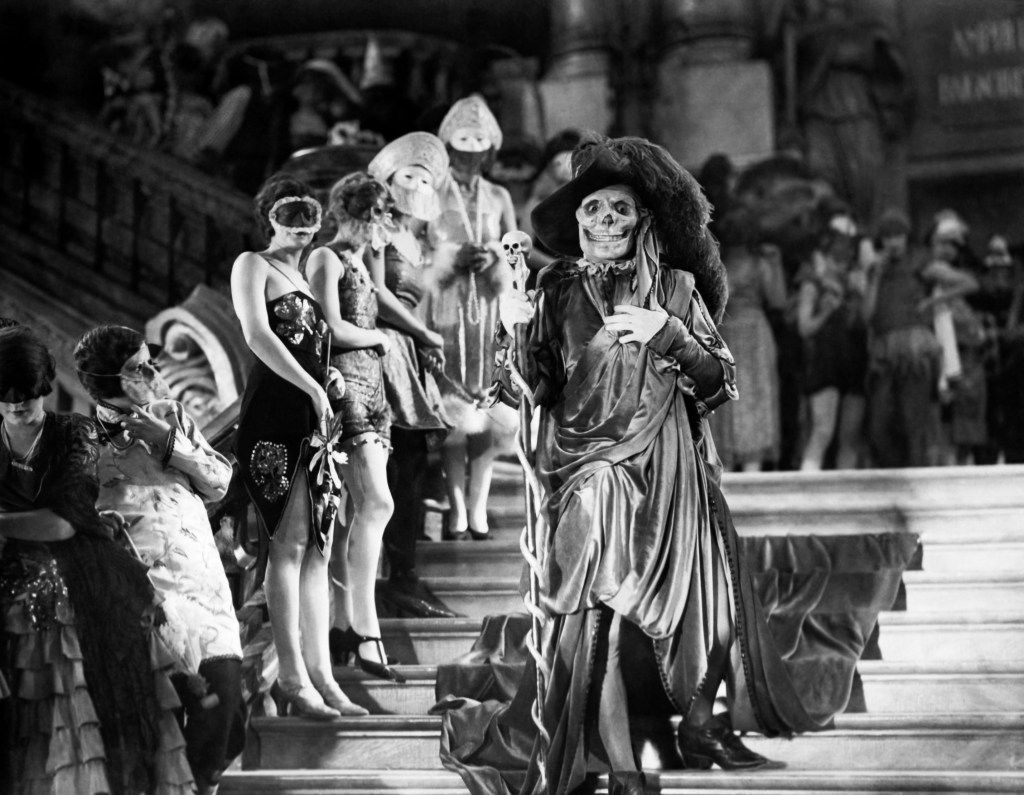
With the multiple versions available, many which are free to watch, I won’t be going into much detail with the plot of the film. The basic plot is that a mad man named Erik (Lon Chaney) lives underneath the Paris Opera House. He is a self taught musician and “master of the Black Arts” who escapes from an island for the mentally ill and takes up camp in the catacombs beneath the Paris Opera House. He becomes infatuated with a young singer, Christine Daae (Mary Philbin), and begins coaching her as a secret voice within the walls. A nobleman, Viscomte Raoul de Chagny (Norman Kerry), is also vying for Christine’s love.
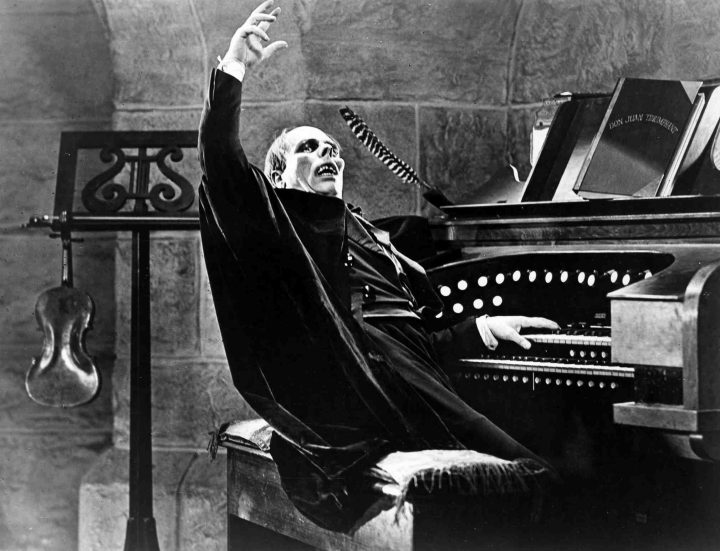
The Phantom begins murdering, poisoning, and generally scaring people at the opera house as he clears a path for Christine’s stardom. Things all come to a head when he crashes a chandelier on the crowd, kidnaps Christine, and professes his love for her. He continues to allow her to perform and come and go as she pleases while living with him under the opera. He also gives her one rule: don’t remove his mask.

Obviously she doesn’t listen to Erik and yanks his mask off in one of cinema’s greatest and most iconic reveal scenes. She then schemes with Raoul to escape from Erik but, as luck would have it, the Phantom overhears their plans.
A second man enters the fray. This man has also been lurking in the catacombs and around the opera house. He’s even accused of being the Phantom at times. In reality, he’s Inspector Ledoux (Arthur Edmund Carewe), who has been tailing the escaped Erik for a long time and now plans to put an end to his reign of terror. He and Raoul team up to save Christine.

In true Universal Horror fashion, a mob is formed by one of the men whose brother is murdered by the Phantom earlier in the film. When he is murdered varies depending on the version of the film that you watch. In short order the mob finds its way into the catacombs as does Raoul and Ledoux. Raoul and Ledoux get trapped by the Phantom and he forces Christine to decide their fate. Without going into too much more detail, Christine makes a choice, the mob arrives on the scene, and the Phantom runs off into the streets of Paris. You’ll have to watch the film to find out about the shockingly brutal conclusion to the film.

The film is extremely well done in almost all of its versions. Some versions feature more humor than others, but the overall feel of the film is one of doom and dread. The stage built for the film, specifically the catacombs, were all designed with the aid of Ben Caray, who worked at the actual Paris Opera House. The stage was a massive place and was used in many films over the years including Universal’s 1943 remake of Phantom of the Opera starring Claude Rains. Originally called Stage 28, it quickly became known at The Phantom Stage and remained that way until 2014 when it was demolished to expand Universal’s theme park located on the property.

Parts and props from the stage were supposed to be saved from demolition, but I can’t find any information as to the truthfulness of this statement. The only thing that I’ve found so far is that Universal Studios destroyed the stage as promised but also destroyed the set, which was over ninety years old. It’s worth nothing that other sets on the property are older and still stand, but it’s sad to know that such a beautiful work of art was destroyed for the expansion of a theme park.

Modern audiences tend to ignore silent films because they’ve become accustomed to movies with sound, tons of color, and unbelievable special effects. To miss Phantom of the Opera because it is a silent film, however, is a shame because it is one of the best films ever laid on celluloid. Lon Chaney’s performance and self-done makeup alone are worth giving it a look, and it’s a brilliant horror film in its own right.

Watch this film. It’s amazing.
Thanks for reading this post. We’ve passed the halfway mark of October and Thirty-One Days O’Horror will be ending soon. Please comment and share if you’ve enjoyed these posts.
 Ken's Alternate Universe!