


“I wish my cat were here. She’s such a capital one for catching mice.”
Lewis Carroll’s 1865 novel Alice’s Adventures In Wonderland has been adapted for the stage, film, and television multiple times over the years. It all began in 1886 when a musical stage adaptation called Alice In Wonderland was produced by Henry Savile Clarke and Walter Slaughter in London’s West End. The first film adaptation of the novel was 1903’s Alice In Wonderland. It was a silent film directed by Cecil Hepworth and Percy Stow and starred May Clark as Alice. 1951’s animated Alice In Wonderland, produced by Walt Disney Productions, is one of the best known and most popular versions of the story. Kathryn Beaumont voiced Alice in the film. Today I’ll take a look at one of the earliest adaptations of the book, 1915’s silent Alice In Wonderland.

The film starred Viola Savoy in the title role. Despite having appeared in over one hundred stage productions from her infancy to her early teens, Savoy made only two films, Alice In Wonderland and The Spendthrift (1915), and then she permanently retired from acting. Other players in the film included Harry Marks as the Dodo Bird, William Tilden as the Mad Hatter, Louis Merkle as the Dormouse, and Herbert Rice as the White Rabbit.
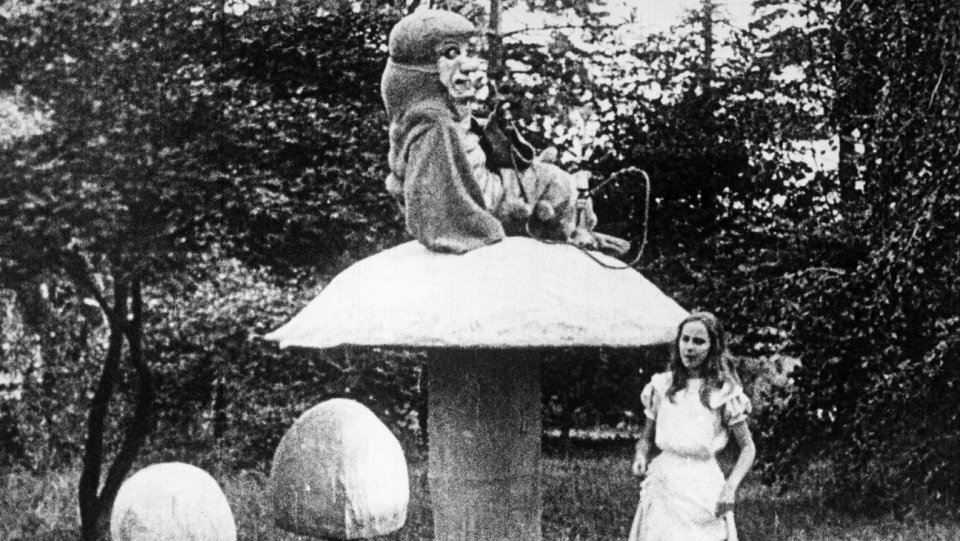
In the film, Alice falls asleep in a meadow while listening to her sister read to her. While dreaming she follows the White Rabbit down a rabbit hole that leads her to a world full of anthropomorphized animals and other bizarre beings. The film then goes through a series of interactions between Alice and the inhabitants of Wonderland. In one of my favorite interactions she attends an animal gathering in which she brags on how well her cat can catch mice, birds, and other animals. Offended by Alice, the animals all leave her one at a time in disgust. It’s just one of a number of humorous interactions that Alice has with characters such as the Cheshire Cat, the Mock Turtle, and the Queen of Hearts.

A few sequences from the film have been lost to time. Most notably, the Mad Hatter’s Tea Party and Alice meeting Humpty Dumpty cannot be found in their entirety. Most available versions of the film, both home media and streaming, run about fifty-two minutes. Some of these versions are completely silent and others include musical accompaniment. Portions of the lost sequences are available online but they aren’t in very good shape.

The film, directed and written by W.W. Young, is basically one mid to wide shot after another in which Alice has her interactions. While not much can be said about Young’s style it should be noted that this is his only directing credit and he also has one editing credit for a documentary entitled The Mystery Of Life (1930). Other than that there isn’t much more listed on IMDb about him. The film should definitely be praised for its elaborate costumes, some of which included moving mouths and blinking eyes. It should also be noted that this is the first film to include stories from both Alice In Wonderland and its sequel, Carroll’s Through The Looking-Glass, And What Alice Found There (1871). Sadly, none of the sequences from Looking-Glass are known to exist. The film is also one of the few adaptations to feature the “You Are Old, Father William” poem.

Is 1915’s Alice In Wonderland a blockbuster? Nah, but it’s still a pretty amazing film full of brilliantly designed characters. It’s definitely worth checking out if for no other reason than to witness one of the earliest film adaptations of Lewis Carroll’s beloved book.
Thanks for checking out today’s post. See you again soon!
 Ken's Alternate Universe!