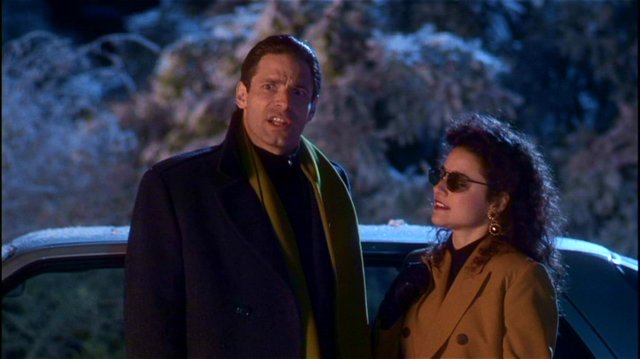
Days O’Horror #14: The Mummy’s Tomb (1942)

Thirty Years Later

A new high priest of Karnak shakes the dust off of the ancient mummy named Kharis and promises to avenge the death of his predecessor in The Mummy’s Tomb. The 1942 film is a direct sequel to 1940’s The Mummy’s Hand and features Lon Chaney, Jr. taking over the role of Kharis, previously portrayed by Tom Tyler.

The film opens up thirty years after The Mummy’s Hand. Steve Banning (the returning Dick Foran) is telling his family the story of how he and his pal, Babe (Wallace Ford, also reprising his role from the previous film), along with the Great Solvani and his daughter, Marta, battled the evil Kharis and his caretaker, Andoheb. Roughly twelve minutes of footage from The Mummy’s Hand is used during this opening sequence and features Peggy Moran and Tom Tyler in their roles as Marta and Kharis, respectively.

Unknown to Steve, Andoheb and Kharis survived the battle. Andoheb (the returning George Zucco) is dying, however, and entrusts the protection of Kharis to a new high priest, Mehemet Bey (Turhan Bey). He makes Bey swear to avenge his death by murdering the entire Banning family so that their bloodline will be lost to history. Bey promises to do so and immediately heads for Banning’s hometown of Mapleton, MA.

Bey takes a job as the caretaker of the local cemetery and wastes no time eliminating members of the Banning family. Steve is the first to be murdered, his neck crushed by Kharis. Soon enough, Steve’s older sister, Jane (Mary Gordon), is also murdered. Prior to her death, Steve’s son, Dr. John Banning (John Hubbard), contacts Babe. When Babe arrives in town, he tells the police that they are dealing with a supernatural being. The police blow off Babe and he is eventually murdered by Kharis as well.

Bey begins seeking out more members of the Banning family and comes across John and his girlfriend, Isobel (Elyse Knox), during a quiet moment together. Bey becomes enamored with Isobel and, forgetting his pledge to Andoheb to only use Kharis for revenge against the Bannings, decides to have Kharis capture Isobel and bring him to her so that he can make her his immortal wife and give him children to extend his own family’s bloodline. Kharis reluctantly does as Bey commands, confused as to why he isn’t supposed to murder Isobel.

Finally convinced that an undead mummy is the cause of the murders, the police and townspeople form a mob and seek out Bey. Bey is shot dead by the sheriff (Cliff Clark), while attempting to murder John Banning, and then the mob gives chase to Kharis, who is fleeing with Isobel in his arms. The film comes to a head at the Banning home. Does Banning rescue Isobel? Will Kharis escape? Watch The Mummy’s Tomb to find out!

I really enjoyed this film. It was great to see many of the actors from the prior film returning in their original roles. Of the new cast, I really enjoyed Elyse Knox as Isobel. She and John Hubbard worked well on the screen together and, simply put, she’s gorgeous. The supporting cast also did fine jobs.

Lon Chaney, Jr. doesn’t have much to do in this film except lumber around and choke people. When it comes time for the face-off with Banning near the end of the film, he gets to flex his muscle a bit. Jack Pierce did a great job of making Chaney look spooky, and even managed to mirror Tom Tyler’s look somewhat from the previous film. Gone, however, are the black eyes that made Tyler’s Kharis so evil looking.

I also want to mention that the Blu-ray edition of this film, part of The Mummy Legacy Collection from Universal, looks wonderful. The picture is crisp and the audio sounds great. This is one of the finest transfers from film to disc that I’ve come across in the Universal Monsters Legacy line.

Thanks for reading my post. The Mummy’s Tomb doesn’t get as much love as other Mummy flicks, but I really like it. It continues Kharis’ story well and adds new and interesting characters to the tale without sacrificing the efforts of those from the previous film.

Days O’Horror #13: She-Wolf Of London (1946)

This Lassie Is A Tad More Vicious

June Lockhart, star of such television programs as Lost In Space and Lassie, heads up a strong cast in a werewolf film that has everything but the werewolf in 1946’s She-Wolf Of London. The film is considered a part of Universal’s classic monster films despite being a psychological thriller and not a traditional monster movie.

In the film, Phyllis Allenby (Lockhart) is preparing to marry her boyfriend, Barry Lanfield (Don Porter). Unfortunately for Phyllis, her “Aunt” Martha (Sara Haden) has a few plans of her own. Martha has been keeping a secret from not only Phyllis, but her own daughter, Carol (Jan Wiley), as well and the family’s housekeeper, Hannah (Eily Malyon). I won’t reveal that secret here, but I will say that Phyllis and Barry’s wedding has something to do with it.

Phyllis is supposed to be happily preparing for her wedding but instead, she’s battling with the possibility that she has fallen under the “curse of the Allenbys.” What’s the curse? Apparently the Allenby family has a few werewolves in the family tree.

Bodies are starting to pile up in the park near the Allenby home and Phyllis is waking up each morning with blood on her hands, a wet robe, and muddy shoes. Aunt Martha feeds Phyllis’ suspicions by encouraging her to keep her “curse” and her late night activities a secret from everyone, including her “cousin,” Carol, and her fiancee, Barry.

Scotland Yard is attempting to figure out who or what might be behind the vicious murders in the park. Barry is doing a little investigating of his own. Martha forbids Phyllis from seeing anyone and stops Carol from seeing her own boyfriend, Dwight (Martin Kosleck). Hannah, loyal to both Phyllis and Carol, attempts to help both of them see their suitors. Eventually she discovers Martha’s dark secret, and things become deadly inside Allenby Mansion.

The film might be called She-Wolf Of London, but there’s no actual werewolf in the film. Throats are being ripped out, but it’s part of a huge scheme to eliminate Phyllis from the picture so that Martha can remain in the Allenby home. The film works very well as a thriller, but horror fans might be turned off by the fact that no fur or fangs come into play.

Despite zero werewolves, the film is still enjoyable. The cast features Lockhart in an early film role and Don Porter, who would go on to star in the successful television show, Private Secretary. He also starred in Gidget along with Sally Field and The Ann Sothern show. Sara Haden is devilishly wonderful as Phyllis’ wicked aunt. Eily Malyon stole the show as Hannah.

Lockhart and Porter had exceptional chemistry on the screen. I immediately bought into the fact that these two people were deeply in love. Lockhart’s spiral into madness was believable as well. There were no weak members in the cast.

I really liked this film. It’s not a traditional horror movie nor is it even that long. It clocks in at just over an hour, so if you’re looking for a quick movie full of deception and a sinister matriarchal figure, She-Wolf Of London is exactly what you need to watch.

As always, thanks for reading my post. We’re nearing the halfway point in our Thirty-One Days O’Horror! Stay tuned for even more spooky posts!

Days O’Horror #12: Dracula (1931)

“I never drink….wine.”

It’s the Universal horror film that started it all. It’s the one that made Bela Lugosi a star and established him as the definitive vampire. It’s 1931’s Dracula.

In the film, Dracula (Lugosi) makes his way to London in order to lease property in the city. Hypnotizing and turning real estate agent Renfield (Dwight Frye) into his slave, Dracula travels aboard the Vesta to London. He murders everyone onboard the ship and when police find Renfield alive but apparently insane, they place him in an asylum where he eats bugs and begs for his master to release him.

Dracula begins socializing with the locals and soon befriends Mina (Helen Chandler), her father, Dr. Seward (Herbert Bunston), John Harker (David Manners), and Lucy Weston (Frances Dade). Lucy eventually passes away and Mina begins acting bizarre. As the nights continue to pass, the number of victims begins to climb. Soon enough, Professor Van Helsing (Edward Van Sloan) begins to think that a vampire is loose in London and he starts investigating potential suspects. Assisting him is John Harker, who is worried for Mina, his fiancee.

Van Helsing’s investigation leads him to believe that Count Dracula is a vampire. He uses a number of techniques to determine if Dracula truly is the cause of all of the recent death in the area. Eventually Van Helsing and Harker hunt down Count Dracula and a face-off ensues. Will John and Professor Van Helsing be able to eliminate the count before Mina permanently joins the world of the undead? I’m not telling. Watch Dracula for yourself and find out!

The film has become a favorite of mine over the years. I watch it at least four times a year and always around Halloween. Bela Lugosi made the vampire an attractive, seductive creature, something that would influence just about every vampire film, novel, television series, and comic book to follow. His eyes struck fear into audiences and his slow line delivery made him sound undead according to audiences of the time. He was also considered a sex symbol by many according to the documentary Lugosi: The Dark Prince. He did so well in the role that he was typecast from that point on in his career. Despite being typecast, Lugosi eventually embraced the role and used it to support his family when roles in film and on stage began to thin out.

Other than Lugosi, the cast featured a number of strong performances. Of special note is Dwight Frye as Renfield. His psychotic breakdown throughout the film was simply amazing to watch. He would appear in a total of seven Universal Horror films and in multiple other supporting roles as well. Both Edward Van Sloan and David Manners would appear in other Universal horror films as well.

Universal’s horror legacy rests firmly on the shoulders of Dracula. Sure, other films would come along that would prove more popular and others would be considered better all around, but Dracula was a perfect start to what would essentially become the Universal Horror Shared Universe.

Dracula is a must-see film for film fanatics. I highly recommend it, especially in the month of October. Thanks for reading my post and get ready for another one tomorrow!

Days O’Horror #11: Son of Frankenstein (1939)

Controlled By Vengeance

Hoping to restore his father’s good name, Baron Wolf von Frankenstein moves his family from the good o’l U.S. of A. to the confines of Castle Frankenstein in 1939’s Son of Frankenstein. The film features Boris Karloff in his final run as Frankenstein’s monster for Universal. It’s also the first film to feature Bela Lugosi as Ygor. It proved to be a very popular film and is often cited as the rebirth of the monster movie at Universal.

Wolf (Basil Rathbone) has high hopes that he will succeed in patching up the damage that his father caused, but he is met with immediate hostility by the local villagers at the train station. Once he and his family settle in their home, Inspector Krogh (Lionel Atwill) arrives to offer protection from the locals. Soon enough, Wolf meets the bizarre graverobber called Ygor (Bela Lugosi). Ygor leads Wolf to the monster (Boris Karloff), laying in a comatose state in the Frankenstein family crypt. Little does Wolf know that Ygor has big plans for the creature.

Convinced that reviving the creature and showing that it is really human will win over the villagers, Wolf decides to wake the creature from its comatose state. His plans are kept secret from almost everyone, including his own family.

After the monster awakes, a strange series of murders begin happening in the village. One by one, members of the jury that sentenced Ygor to a hanging death (which he obviously survived) begin to die. Inspector Krogh suspects that the monster is back but can’t find solid evidence to prove his beliefs, so he begins questioning everyone in the Frankenstein home, including Wolf’s young son, Peter (Donnie Dunagan), who claims to have befriended a large man.

It is soon discovered that Ygor is controlling the monster, making him murder the jury members that sentenced Ygor to death. Wolf discovers the truth and shoots Ygor. Enraged, the monster kidnaps Peter and plans to toss him into the boiling brimstone beneath Frankenstein’s laboratory. A fight breaks out between the monster, Krogh, and Wolf. Who lives? Who dies? Watch Son of Frankenstein in order to find out!

This film features an amazingly solid cast. Rathbone is perhaps best known for portraying Sherlock Holmes in fourteen films, but his performance as Wolf von Frankenstein is a bright spot in this movie. He won a Tony Award, was nominated for Academy Awards on two occasions, and also achieved the rank of captain in the British Army and received the Military Cross for his work as a scout in World War One. Jospehine Hutchinson’s Elsa von Frankenstein had an unusually small role when compared to other female leads in Universal Monster films, but nonetheless she did an excellent job. Atwill was fun to watch as the relentless Inspector Krogh. I believe that I enjoyed his performance most of all.

A special note should be made about Donnie Dunagan. About five years old at the time, Dunagan’s performance was excellent. He drew laughs from me every time that he appeared on screen. He would go on to provide the voice of Bambi in the legendary 1942 Walt Disney animated feature of the same name. Eventually he would serve three tours in Vietnam with the Marine Corps. He became the youngest drill instructor in the Marines, received a Bronze Star and three Purple Hearts, and achieved the rank of major. I highly recommend looking up this amazing gentleman on the web and learning more about him.

This film, despite being a direct sequel to Bride of Frankenstein, makes no mention of the bride or of Dr. Pretorius, who supposedly died at the end of Bride. No explanation is given as to how the creature survived that film’s ending either. Also, the monster developed a decent vocabulary in Bride, but thanks to a lightning strike mentioned in Son, he’s lost the ability to speak.

Karloff and Lugosi give fine performances. Outside of his star-making role in Dracula, this is Lugosi’s best performance in my opinion. Karloff had to use grunts, moans, and cries along with body language to show emotion. He did a great job.

Son of Frankenstein slowly won me over. While there are better Universal Monster films out there, it’s definitely one of the best in the bunch. Check it out if you get a chance and, as always, thank you for reading my post.

Days O’Horror #10: Revenge of the Creature (1955)

Marineland’s Newest Attraction

Ocean Harbor Oceanarium (Marineland in Florida) takes center stage in 1955’s Revenge of the Creature. A direct sequel to Creature From The Black Lagoon (1954), Revenge is often looked upon by many as one of the worst sequels in the Universal Monster catalogue. I’m actually one of the few people that likes the film. I’ll give my reasons for liking it later. For now, let’s take a look at the plot.

The film starts with a new expedition entering the Black Lagoon. Aboard a ship captained by the returning Nestor Paiva as Lucas, the group captures the creature and brings it to Florida in order to study it. Ocean Harbor Oceanarium becomes the creature’s unwanted home and it becomes the subject of study for Dr. Clete Ferguson (John Agar) and ichthyology student Helen Dobson (Lori Nelson).

Despite an age difference and advances from fellow researcher Joe Hayes (John Bromfield), Helen and Clete develop feelings for one another. Despite a species difference, the creature, or Gill-man as he is referred to in the film, also falls for Helen. He becomes obsessed with her as she and Clete continue their research.

After a number of failed attempts to escape, the Gill-man finally breaks out of the Oceanarium. People die, a car is flipped, and the creature makes a break for the ocean.

Believing that Gill-man is returning to his home in the Black Lagoon, Helen and Clete become somewhat lax about the whole ordeal despite multiple eye-witness claims of seeing the creature up and down the coast.

Eventually the Gill-man gets his hands on Helen. Clete and other researchers from the Oceanarium team up with local law enforcement in a desperate attempt to locate Helen and kill the creature. More people die and Clete and the Gill-man have a final face-off. Who wins? I’m not telling. You’ll have to watch Revenge of the Creature to find out.

I’d be a fool to say that this film is a great work of art. The many criticisms that it has received over the years are justified, but for some reason I really enjoy this film. The addition of Chris (a German Shepherd that appears in the film…..that takes place in a marine park) seems extraneous. The terrible fight sequence where Gill-man throws a young man at a palm tree and the viewer can clearly tell that the man is suspended by cables is simply a pain to watch. The excessive nods to the actual park, including an extended dolphin show sequence, are nothing more than a blatant advertisement for Marineland Florida (where most of the film was shot). All of the sea park shots reminded me of another ill-received classic, Jaws 3-D. It was a feature length commercial for Sea World in Orlando, FL.

Despite these and other shortcomings, though, this film still has a few things going for it. For starters, Revenge is the film debut for Clint Eastwood. It’s funny seeing him in this early role as an inept lab assistant. His moment is brief but humorous and gives absolutely no indication that he’ll eventually become a major box office draw.

The film also features one of the best performances by a guy in a suit. Ricou Browning (underwater scenes) returns and Tom Hennesy takes over as the creature on land in this film. Browning is especially solid in his performance. You can easily see how the creature is attracted to Helen and how it feels trapped in the aquarium. The rest of the cast also do great jobs although John Bromfield’s performance can be a bit much at times.

I’m also a fan of the Gill-man’s escape sequence. The audience gets hammered by the creature’s iconic theme as it runs through the sea park, terrorizing the innocent and smashing a skull or two along the way. The sequence plays out much like the initial dinosaur escape in Jurassic World, with screaming families and people stumbling all over the place.

I won’t tell you that this film is a must see movie, but I will say that it’s a fun way to kill an hour and twenty minutes. Watch it before heading out on the lake or prior to a visit to Sea World. It’ll put you in the perfect mood for those things.

Thanks for reading. I’ll see you all tomorrow.

Days O’Horror #9: Son Of Dracula (1943)

A Wolf In Dracula’s Clothing

1943’s Son Of Dracula misses the mark. I hate saying that because I’m a huge fan of its star, Lon Chaney, Jr., but the story never seems to find its footing. Chaney is well known for playing not only the Wolf Man, but also Frankenstein’s monster, the Mummy, and Dracula in various films in those franchises. His work as Count Alucard in Son of Dracula, though, is quite forgettable.

The film’s plot centers around a wealthy family, the Caldwells, in New Orleans and how one of the Caldwell daughters schemes to become both wealthy and immortal. Katherine Caldwell (Louise Allbritton) uses Count Alucard in a dastardly plan to eliminate her ailing father, Colonel Caldwell (George Irving), gain immortality, and eventually take control of the entire family estate by removing her sister, Claire (Evelyn Ankers), from the picture. She also plans on having her boyfriend, Frank Stanley (Robert Paige), murder the Count once she is immortal, and promises to make him a vampire so that they can live together forever.

The plot is somewhat muddied, but I do like how it has a human (Allbritton) manipulate the vampire (Chaney) in order to gain power. In almost every other vampire film, Universal or otherwise, it is always the vampire that manipulates humans to get what it wants. This was a fresh take on the vampire story, but is was executed poorly in my opinion.

Chaney seems out of place as Alucard (Dracula spelled backwards) and his on screen presence comes off a bit humorous to me. Paige does a fine job as Frank, who battles with the sudden marriage of his girlfriend to the mysterious Count and then spirals out of control as she reveals her true plans AFTER he believes that he accidentally murdered her. The rest of the cast, especially Frank Craven, Evelyn Ankers, and J. Edward Bromberg, give solid performances as well.

It should also be noted that the brother and sister of Oscar winner Hattie McDaniel, also appear in this film as servants at the Caldwell Estate. Sam and Etta McDaniel have small roles but do fine jobs with their performances.

The real star of this film is Allbritton. Her portrayal of the manipulative and glory-hungry Katherine shines despite a weak script and a sometimes dull film. There is never any doubt that she is in control not only of Alucard, but of Frank as well. Had the film itself been better, this movie might have become a favorite of mine.

Special effects master John P. Fulton once again shows off his skills on the screen. Son of Dracula is the first horror film to depict a vampire transforming from a bat into human form. Alucard also didn’t creak open his casket when he rose in the evening, opting instead to transform into a mist in order to slink out of the coffin. Alucard’s materialization out of the mist looked great on the screen and was an excellent plot device that allowed him to move throughout the film without being detected.

It’s a shame that this film wasn’t that good. It had a unique plot, trailblazing special effects, and a performance from Allbritton that deserved a better film. Chaney was miscast in this movie in my opinion, but he was excellent in so many other films that this performance is forgivable.

Thank you for reading my post. I saw Joker last night and plan on reviewing it in addition to my regular Thirty-One Days O’Horror posts later this week.

Days O’Horror #8: The Invisible Man Returns (1940)

A Murderer Unseen

More murder mystery than horror film, 1940’s The Invisible Man Returns is an excellent sequel to 1933’s The Invisible Man. It features Vincent Price in his second horror film role (the first being in 1939’s Tower of London) and a number of actors who would appear in multiple Universal Monster films and one gentleman who would go on to help a certain caped crusader. I’ll get to that particular detail later.

Although Claude Rains’ enigmatic character passed away in the original film, his formula for invisibility was still very much alive and protected by his brother, Dr. Frank Griffin (John Sutton) in The Invisible Man Returns. When his friend and coal mine owner, Sir Geoffrey Radcliffe (Vincent Price), is wrongly sentenced to death for the murder of his own brother, Griffin agrees to help him escape from prison. At the beckoning of Radcliffe’s fiancee, Helen (Nan Grey), Griffin visits Radcliffe in prison just hours before his death. He injects him with the invisibility drug in order to allow him to sneak out of the prison and go into hiding until proof of his innocence can be discovered.

Griffin warns both Helen and Radcliffe that the drug will drive Radcliffe mad if he isn’t restored to visibility soon. Griffin races to find a way to reverse the effects of the drug while dodging questions from Inspector Sampson (Cecil Kellaway), a Scotland Yard detective that is familiar with the original case of the Invisible Man.

In the meantime, Helen hides Radcliffe in a country home. Risking discovery and driven by the maddening effects of the invisibility drug, Radcliffe seeks out the true murderer of his brother by returning to the coal mine and forcing one of his former employees, Willie Spears (Alan Napier), to reveal the true murderer’s name: Richard Cobbe (Sir Cedric Hardwicke).

With Sampson hot on his heels and Griffin struggling to find an antidote, Radcliffe’s desires for justice turn into a longing for vengeance. He hunts down Cobbe and reveals to him that he knows the truth. The two fight and Griffin chases Cobbe into the coal mine where Cobbe is mortally wounded. Just prior to his death, however, he confesses to the murder of Radcliffe’s brother, proving Radcliffe’s innocence.

Gunshot by Sampson, Radcliffe is slowly dying. Unable to operate on him because of his invisiblity, Dr. Griffin decides to use an antidote that had unsuccessful results in his lab in desperation. Before doing this, however, he gives Radcliffe a blood transfusion. The transfusion proves to be the cure for Radcliffe’s invisibility and he is saved from death.

This film was very captivating. It held my attention the entire time and featured excellent acting, music, and special effects. Despite barely being on the screen, Vincent Price gives an amazing performance as Radcliffe. The rest of the cast was great as well.

Not only did the film feature Vincent Price, a horror icon in his own right, but it also featured a number of other notable actors. Cecil Kellaway appeared in The Mummy’s Hand (1940) and The House of the Seven Gables (1940) and was nominated for the Academy Award For Best Supporting Actor in two films. Cedric Hardwicke appeared in 1942’s The Ghost of Frankenstein and was a prolific stage and screen actor. Some of his other roles include Jean Frollo in The Hunchback of Notre Dame (1939), Pharoah Sethi in The Ten Commandments (1956), and Bishop Myriel in 1935’s Les Miserables. Nan Grey starred alongside Kellaway in The House of the Seven Gables, with Price in Tower of London, and played the scandalous role of Lili in Dracula’s Daughter (1936).

Despite having a career that spanned just over fifty years and featured roles in films as varied as Joan of Arc (1948) and The Song of Bernadette (1943), Alan Napier is perhaps best known for his role as Alfred Pennyworth, the loyal butler of Adam West’s Bruce Wayne/Batman in the 1960’s television series and film, Batman. Napier also starred in episodes of The Beverly Hillbillies and The Twilight Zone.

John P. Fulton returned to provide the film’s special effects. His effort, along with that of Bernard B. Brown and William Hedgcock, resulted in an Oscar nomination. Fulton won three Oscars for Special Photographic Effects and was nominated a total of eight times in that category. Brown won an Oscar for Best Sound in When Tomorrow Comes (1939) and was nominated a total of eight times in that category. He was also nominated three times in the Visual Effects category.

The Invisible Man Returns is an excellent film. It’s one of the best sequels in any of the Universal Monsters franchises. It was loaded with talented and award-winning actors and crew members and the horror legend that is Vincent Price. It’s definitely worth checking out and I recommend it.

Thanks for reading this post. Tune in tomorrow for another exciting Thirty-One Days O’Horror entry!

Days O’Horror #7: Bride of Frankenstein (1935)

Alone: Bad. Friend: Good.

While Universal had plenty of successful horror films under their belt by 1935, they had yet to produce a sequel. Bride of Frankenstein changed all of that and set a precedent that almost no other sequel managed to achieve. Considered by many to be one of the best sequels ever made and also a triumph over its predecessor, 1931’s Frankenstein, Bride of Frankenstein featured an amazing story, key returning cast members from the original film, and a female monster that remains as one of the most iconic creatures ever to grace the screen.

The film opens with Lord Byron (Gavin Gordon) waxing poetic about Mary Shelley’s (Elsa Lanchester) story of Frankenstein’s monster. Her husband, Percy Bysshe Shelley (Douglas Walton) echoes Byron’s sentiments about the tale. Both of them feel as if there’s more to the story, though, and Mary is quick to tell them that there is indeed more story to come.

The film then jumps directly into the ending of Frankenstein as the windmill is being destroyed. Villagers cheer as the windmill burns, but it is soon revealed that the creature (Boris Karloff, billed only as Karloff in the film) has survived whenever he murders both the father and mother of the young girl that he accidentally killed in the first film. The monster walks up on a villager (the brilliant Una O’Connor) and startles her. She races to the village to warn the others.

At the same time, it is discovered that Henry Frankenstein (Colin Clive) has also survived the fire and he is reunited with his fiancee, Elizabeth (Valerie Hobson). One of his old mentors, Dr. Septimus Pretorius (Ernest Thesiger), arrives on the scene and attempts to convince Frankenstein that the monster needs a partner. He wishes to work with Frankenstein to bring the female creature to life, but Frankenstein is hesitant to join him.

Meanwhile, the monster stalks the countryside looking for food, shelter, and, most importantly, acceptance. After encounters with locals, including yet another angry mob, leave him gunshot and burned, he stumbles onto the home of a blind hermit (O.P. Heggie) who takes him in, befriends him, and teaches him how to speak. Eventually a pair of hunters discovers the hermit and the creature and a fight ensues. The hermit’s cottage is destroyed and the creature runs out into the forest. Another mob is formed and the creature hides in a crypt where he has a run-in with Dr. Pretorius.

Using the creature as a pawn in his game by having him capture Elizabeth, Pretorius forces Frankenstein to help him create a female creature. The duo is successful in their creation, but much like the rest of society, the “bride” of Frankenstein rejects the creature. Dismayed by humanity and heartbroken over his rejection by the bride, the creature collapses the laboratory on himself, Pretorius, and the newly created bride. He allows Frankenstein and Elizabeth to escape, telling them to “Go! You live!”

Colin Clive, Dwight Frye, and Boris Karloff all returned for this sequel to Frankenstein. Since his character Fritz was killed in the original film, Frye played Karl, the twisted assistant of Pretorius. Valerie Hobson, only seventeen years old at the time, was brought in to replace Mae Clarke as Elizabeth, as Clarke was too sick to reprise the role. Hobson also starred in Werewolf Of London (1935) and both Frye and Una O’Connor had roles in other Universal films, most notably Frye in Dracula (1931) and O’Connor in The Invisible Man (1933).

Elsa Lanchester portrayed two roles in the film. She bookended the story as Mary Shelley in the beginning and the Bride in the final moments. The Bride is on the screen for less than five minutes but the impact of Lanchester’s jerky movements, piercing scream, and ghastly hisses left their mark on audiences in the 1930’s and can still be felt today.

The Bride never officially made another appearance in a Universal film, but she has popped up in everything from cartoons to comics and has been hinted at, homaged, or featured in everything from Young Frankenstein (1974) to The Bride of Chucky (1998) and dozens of other films and television shows. There have been toys, model kits, posters, costumes, and other items created featuring her image as well.

Lanchester’s Bride is the only female Universal Monster to be featured prominently in any of their promotional material. Her closest competition, Countess Marya Zeleska (Gloria Holden, Dracula’s Daughter, 1936), was also influential but is treated as nothing more than a footnote in most documentaries about Universal Monsters.

While the film was definitely a thriller, it had a much deeper message of loneliness and its damaging effects. The creature wants acceptance and friendship, which he gains in the form of the hermit, but is ultimately rejected by the one person that he truly wants to love, the Bride. Near the end of the film, Karloff utters one of the most famous and powerful lines: “She hate me. Like others.” Those six syllables are brilliant and moving, as they give the audience major insight into the creature’s feelings of loneliness and rejection.

Bride of Frankenstein proves that a sequel can be better than its predecessor. It has a heartbreaking story, great music, and brilliant direction from James Whale. The emotional struggle of Karloff’s creature is powerful in this film and despite ton of Jack Pierce makeup, we all feel the creature’s pain when the Bride rejects him.

I definitely recommend watching this film. It’s one of the best Universal Monster films and one of the greatest films in cinematic history in my opinion. Thanks for reading this post. There are more to come!

Days O’Horror #6: Werewolf of London (1935)

Driven By Desire

Six years prior to the popular Lon Chaney, Jr. film, The Wolf Man, Universal bared its claws with 1935’s Werewolf Of London. The film starred Henry Hull as Dr. Wilfred Glendon, a man that struggles with the terrible truth that he has become a werewolf and wants nothing more than to murder the one that he loves.

The film is considered to be the first werewolf film released by a major studio. The Werewolf, a silent film released in 1913, is recognized as the first werewolf film ever made.

As is the case with many Universal Monsters films, Werewolf of London begins with an expedition. This time around, the expedition is of a botanical variety and it takes place in Tibet. Glendon and a colleague enter a forbidden area looking for the mariphasa plant, a plant that only blooms by moonlight. While searching for the plant, Glendon is attacked by a creature. He manages to survive, but after returning home he begins to have a craving for blood.

Glendon becomes extremely secretive about his discovery and research and alienates his wife, Lisa (Valerie Hobson), and neglects his social duties. On one particular evening, Lisa manages to pry Glendon away from his laboratory for a gathering. At the party, he meets one of Lisa’s old flames, Paul Ames (Lester Matthews), and there’s tension between the trio almost instantly. Paul doesn’t hide the fact that he still has feelings for Lisa and Glendon becomes very protective of her.

Glendon also meets Dr. Yogami (Warner Oland), a botanist that claims that he and Glendon had an encounter in Tibet. Glendon doesn’t remember their meeting, but Yogami’s knowledge of the mariphasa plant intrigues him. Yogami tells Glendon that the mariphasa plant has properties that can prevent one from transforming into a werewolf, but Glendon brushes him off. Yogami also warns Glendon that a werewolf is driven by a desire to kill the one that he loves the most.

Dr. Glendon soon realizes that he is affected by moonlight. Before he can try using the mariphasa plant to save himself, the two opened blooms are stolen from his laboratory. Unable to resist the transformation, Glendon turns into a werewolf and murders a young woman. Desperate, he isolates himself from the rest of the world. Lisa and Paul become closer, the body count rises, and a second werewolf enters the fray. Can Dr. Glendon discover the identity of the other werewolf? Will he save his marriage? Can he stop his inner cravings to kill? You’ll have to check out Werewolf of London in order to find out!

Glendon’s werewolf and its story are unique in many ways. For starters, Glendon appears to be somewhat aware of what is going on while he’s a werewolf. His transformation is more like Dr. Jekyll and Mr. Hyde than that of a traditional werewolf. He’s aware enough to put on a coat and hat before going out to hunt and it isn’t until he sees Lisa that he seems to become blinded by the desire for her blood. Silver bullets are not necessary to stop him and there appears to be a scientific way of treating his lycanthropy. The film also features a love triangle and a secondary werewolf that manipulates the story as it goes along, two elements that don’t always appear in a werewolf film.

The stars of this film do great jobs. Hull is particularly solid as Dr. Glendon. Viewers can easily see the internal struggle raging inside of Glendon as he attempts to save himself and others. Jack Pierce, best known for his makeup work on The Wolf Man, also did the makeup for Werewolf Of London, and Hull’s wolf looks a lot more dapper than Lon Chaney, Jr.’s wolf man.

The film isn’t as well known as other werewolf movies, but its influence can be seen in films such as An American Werewolf In London and heard in the popular song Werewolves of London by Warren Zevon.

I really liked this film. A strained relationshiip made even more so by a man’s need for isolation mixed together with a second werewolf intent on saving itself makes for a great tale. Watching Hull spiral out of control was excellent as well.

If you haven’t seen this oft forgotten gem, give it a chance. You’ll be pleasantly surprised.

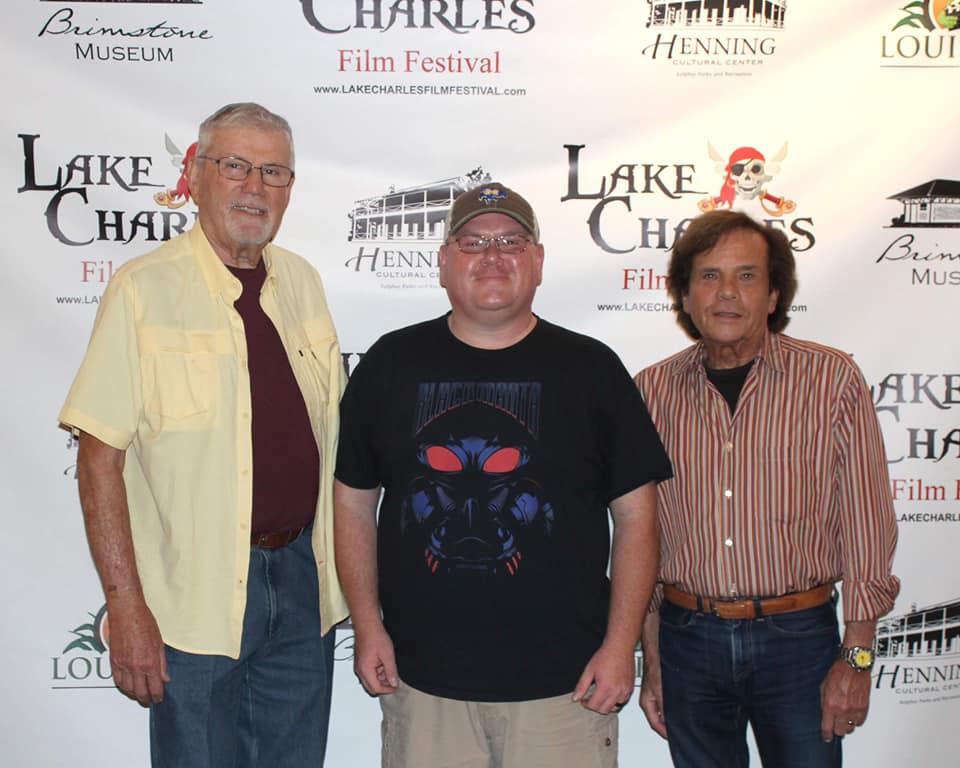
Thank you for reading my post. I’ll have another one tomorrow and will also be posting about the Lake Charles Film Festival very soon!
Days O’Horror #5: Creature From The Black Lagoon (1954)

Don’t Go In The Water!

1954’s Creature From The Black Lagoon features one of the most iconic monsters in all of film history. The film was released in 3D, a dying format at the time, but was viewed in 2D as well. The film and its two sequels are considered the final installments in Universal’s classic monster films.

The film’s plot is rather simple. An expedition in the Amazon discovers a fossilized hand that might prove to be a link between sea creatures and land animals. The hand is webbed for swimming and has claws for digging into or tearing things apart. The expedition’s lead scientist, Dr. Maia (Antonio Moreno), heads back to Brazil to show his findings to his colleagues. There he runs into one of his best students, Dr. David Reed (Richard Carlson), and his girlfriend and fellow researcher, Kay Lawrence (Julia Adams, sometimes listed as Julie Adams).

The duo join Dr. Maia’s expedition along with Dr. Reed’s boss, Dr. Mark Willams (Richard Denning), another scientist named Dr. Edwin Thompson (Whit Bissell), and the crew of the Ria, captained by Lucas (Nestor Paiva). When the group arrives at Maia’s camp, they discover that his assistants have been murdered by some type of beast. This doesn’t stop the group for continuing to look for more fossils of the creature, and they eventually end up in the Black Lagoon.

The creature attacks the crew of the ship and expedition. It becomes fond of Kay and stalks her as she swims. Eventually the crew captures the creature but it escapes and causes more chaos. It blocks the entrance to the lagoon so that no one can escape its clutches and a great battle between the creature and the surviving members of the expedition takes place. Who lives? Who dies? You’ll have to check out Creature From The Black Lagoon in order to find out!

This film has quickly become one of my favorite Universal Monster films. The simplicity of the story, the wonderful Gillman designed by Milicent Patrick, the excellent performances by the actors, and the solid cinematography (especially the underwater shots) all make for a great film. This film also has the best music of all of the Universal Monsters films in my opinion.

Milicent Patrick, designer of the Creature.

Two men donned the suit of the Gillman. Ben Chapman did all of the land-based sequences and Ricou Browning was filmed in the underwater scenes. Browning is still alive as of this writing and is one of the final living cast members of any of the classic Universal films. Sadly, Julia Adams passed away in February of this year. Ginger Stanley, Julia Adams’ stunt double in the film, is also still alive.

Ricou Browning.
Ginger Stanley, Julia Adams’ stunt double.

The story of Milicent Patrick, the designer of the Gillman, is an amazing one. If you have the chance, pick up The Lady From The Black Lagoon by Mallory O’Meara. It’s a wonderful book about the struggles of Mrs. Patrick as she made her way in a world and industry dominated by men.

Julia Adams

I was fortunate enough to get an autographed photo from Julie Adams just prior to her death. It is my one and only Universal Monsters autograph and it has quickly become one of my most cherished possessions. She wasn’t just a great actress, but a wonderful person as well.

Every time that I watch Creature, I fall more and more in love with it. While I doubt that it will ever dethrone The Wolf Man as my favorite Universal Monster film, it will always be one of the best ones in my heart.

Thank you for reading my post. It’s a tad late, but it highlights a great film. I’ll be posting Day O’Horror #6 very soon!